Natural Remedies - Healing with Medicinal Herbs
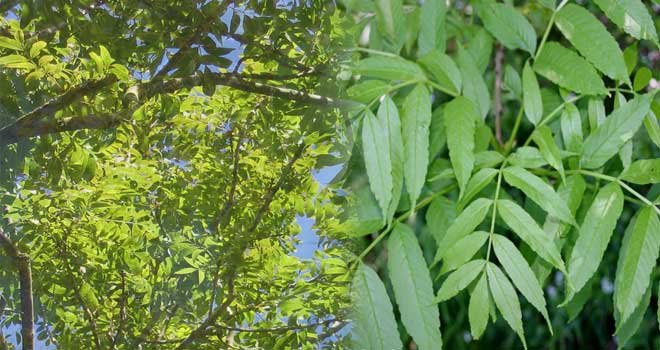
Common Ash (Fraxinus excelsior Oleraceae)
Other Names: European White Ash, Mountain Ash, Large Ash
This large deciduous tree can grow up to 25 meters tall, with an erect trunk covered in smooth, grayish bark. Historically called "European quinine" due to its fever-reducing properties, the common ash has leaves composed of 9 to 15 pointed, serrated leaflets. Small brownish flower inflorescences appear in April and May before the leaves. Its firm, winged fruits each contain a single seed.
Parts for Use
Leaves and Bark
- Leaves are harvested in June and July, separated from the central stem, spread in a thin layer, and dried in a shaded area.
- Dried leaves are used for infusions or ground into powder for capsules.
- Bark, harvested from young trees in spring, is used to make decoctions.
Ingredients
The active ingredients include iridoids, tannins, flavonoids, and coumarins, which contribute to the plant’s anti-inflammatory properties. Its diuretic effects are likely due to mannitol and potassium salts.
Use in Treatment
Common ash leaves are known for their anti-inflammatory effects, particularly in treating rheumatism. A 1995 German laboratory study documented the plant’s ability to prevent multiple inflammatory processes. Earlier German animal studies in 1989 demonstrated that common ash produces anti-inflammatory, analgesic, and antipyretic effects comparable to salicylic acid and indomethacin. French researchers in 1980 found that common ash stimulates the immune system in mice infected with Escherichia coli. As a tonic, an infusion of ash leaves mixed with black currant, meadowsweet, and mint creates a refreshing drink. The bark has long been used as an astringent and to reduce fever.
Cultivation
Common ash should be planted in well-drained, neutral to alkaline soil in a sunny or partially shaded location.
Preparation and Dosage
For Internal Use (Kidney Stones, Rheumatism, Gout, Edema, Water Retention, Obesity)
- Infusion: Place 10 to 20 grams of dry leaves in one liter of boiling water, let stand for 10 minutes, strain, and drink 0.5 to 1 liter daily.
- Capsules (300 mg): Take two capsules with a large glass of water three times daily.
For Fever
- Tincture: Add 50 drops to a glass of water and take three times daily.
- Decoction: Place 50 grams of dried bark in one liter of boiling water, cook for 10 minutes, strain, and drink three to four cups daily.
Warnings
- No adverse effects have been observed, even with prolonged use.
- Consult a doctor if taking common ash alongside painkillers.