Natural Remedies - Healing with Medicinal Herbs
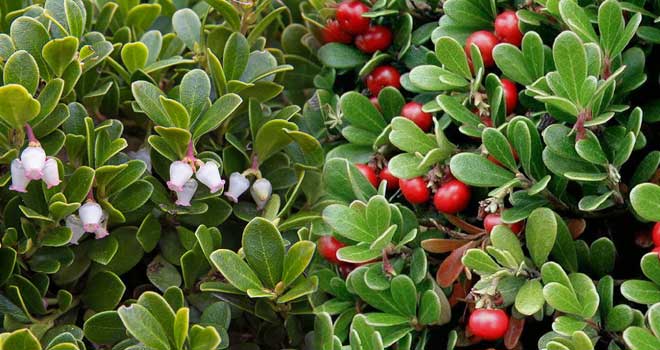
Bearberry (Arctostaphylos uva-ursi Ericaceae)
Other Names: Kinnikinnick, Mealberry, Sandberry, Hog-Crawberry
This small, low-growing shrub is found in the mountainous regions of Europe, Asia, and North America. It has woody, highly branched stems that creep across the ground. Its evergreen, leathery, spatulate leaves are complemented by beautiful waxy flowers in early summer, which are white with slight red markings. In autumn, these flowers produce bright red berries.
Parts for Use
Leaves
- Evergreen leaves can be picked year-round, with the youngest leaves selected for use.
- Dried outdoors, the leaves are used to prepare infusions or dry extracts for powders, tinctures, and capsules.
Ingredients
Bearberry contains phenolic glycosides, particularly arbutin, which converts into antibacterial hydroquinones in the body. It also includes allantoin, tannins, and diuretic flavonoids.
Use in Treatment
Numerous studies confirm that bearberry’s phenolic glycosides, especially arbutin, convert into hydroquinones in the body, acting as potent antibiotics. Bearberry is highly effective for urinary tract infections like cystitis and urethritis, as well as ulcers caused by Staphylococcus aureus, food poisoning, and diarrhea. It is more effective against bacteria causing urinary tract infections when the patient’s urine is alkaline rather than acidic. During treatment, a diet rich in fresh fruits and vegetables, with minimal meat and dairy, is recommended to maintain alkaline urine. Alternatively, prescribed doses of baking soda can help. Animal studies also confirm bearberry’s anti-inflammatory properties.
Cultivation
Bearberry can be grown from seeds in the fall or cuttings in the summer. It thrives in sunny or slightly shaded locations.
Preparation and Dosage
For Internal Use (Urinary Tract Infections)
- Infusion: Place 3 grams of dried, powdered leaves in a cup of boiling water, let sit for 10 minutes, strain, and drink three to four cups daily.
- Tincture (1:1 in 25% alcohol): Take 2 to 4 ml daily.
- Liquid Extract (1:1 in 25% alcohol): Take 1.5 to 4 ml three times daily.
- Capsules (100–200 mg of dry extract): Take one to two capsules three times daily with meals.
Warnings
- Consult a healthcare professional before use.
- Do not use bearberry preparations during pregnancy or breastfeeding.
- Avoid giving bearberry to children under 12 years old.
- Bearberry is not recommended for individuals with kidney diseases.
- High tannin concentrations may cause nausea.
- Due to its high tannin content, which can cause liver damage in large quantities, treatment should not exceed one week.
- Limit to five treatment courses per year.