Natural Remedies - Healing with Medicinal Herbs
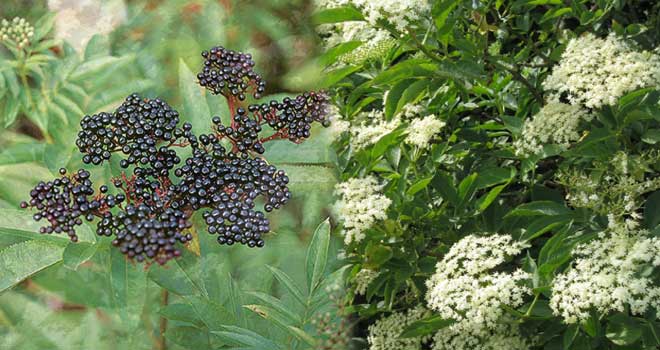
Black elderberry (Sambucus nigra Caprifoliaceae)
Other Names: Elder, Elderberry, Black Elder, European Elder
Native to Europe and North America, this deciduous tree or large shrub can grow up to 10 meters tall. In May, large, flat inflorescences of tiny white flowers emit a pleasant sweet scent. These flowers produce small black berries filled with dark purple juice in early autumn.<
Parts for Use
Flowers, Berries and Inner Bark
- Flowers are harvested in late spring during full bloom and dried for use in infusions and decoctions.
- Berries are picked when ripe, typically in early autumn.
- The fresh inner bark, obtained by peeling the blackish outer layer, is used less frequently.
Ingredients
Black elderberry flowers contain tannins, potassium, mucilage, phenols, and flavonoids. The bark contains sambucin, a substance similar to an alkaloid. Berries, commonly used in syrups, jams, and wines, are rich in anthocyanins, folic acid, and vitamins A and C, as well as flavonoids. They also contain cyanogenic glycosides, which are toxic in large quantities.
Use in Treatment
Black elderberry flowers and berries act as expectorants and induce sweating, helping to lower body temperature and expel toxins, making them effective for colds and flu. In 1990, Bulgarian researchers found that elderflower extracts have antiviral effects against herpes simplex type 1 and influenza A and B. Recent clinical studies from Israel showed that elderberry extract slows various influenza viruses, significantly speeding up flu recovery if taken early. A 1983 French study confirmed the diuretic effects of black elderberry preparations and noted that the berries are mildly laxative. Elderberry extract serves as an anti-inflammatory mouthwash for sore throats, inflamed gums (gingivitis), and oral cavity inflammation. The roots may have insecticidal properties, as badgers rub against them to kill lice, suggesting that a decoction could treat head lice.
Cultivation
Black elderberry thrives in rich, moist soil in sunny or slightly shaded locations.
Preparation and Dosage
For Internal Use (Flu, Colds, Fever, and Mucositis)
- Infusion: Place 2–5 grams of dried flowers in a cup of boiling water, let sit for 10 minutes, strain, and drink at least three cups daily.
- Capsules (50–100 mg dry extract): Take one to two capsules two to three times daily before meals.
- Tincture (1:5 in 25% alcohol): Take 20 drops in a glass of water three times daily after meals.
For Sore Throat, Inflamed Gums (Gingivitis), or Oral Cavity Inflammation
- Decoction: Place 50 grams of flowers in 1 liter of boiling water, boil for 5 minutes, let cool, and use for gargling or as a mouthwash four to six times daily, especially after meals.
Warnings
- Consult a healthcare professional before use.
- Do not use black elderberry during pregnancy or breastfeeding.
- Avoid eating raw berries, as they can cause nausea and vomiting.
- Excessive or prolonged use may lead to significant potassium loss through urine.
- Despite the presence of small amounts of cyanogenic glycosides, no harmful side effects have been reported.