Natural Remedies - Healing with Medicinal Herbs
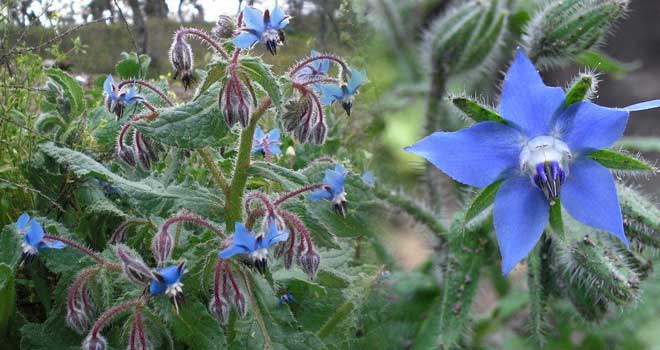
Borage (Borago officinalis Boraginaceae)
Other Names: Common Borage, Starflower, Tailwort, Cool-Tankard
Borage, a herbaceous annual, is often considered a weed by gardeners due to its lush growth in inhospitable soils, along roads, paths, and in flower beds. Covered in sharp hairs, it grows up to 60 cm tall. In summer, bright blue flowers bloom, producing tiny hazelnut-like fruits, each containing one seed.
Parts for Use
Flowers, Leaves and Seeds
- Flowers contain diuretic compounds.
- Seeds are crushed to extract oil.
- Fresh leaves, with a cucumber-like flavor, can be used to enhance summer beverages like eggnog.
Ingredients
Borage leaves and flowers are rich in diuretic minerals but contain pyrrolizidine alkaloids, which may pose risks to liver health and are potentially carcinogenic. The European Commission is considering restrictions on borage products due to these alkaloids. The plant also contains mucilage, which soothes and reduces pain in mucous membrane inflammation. Borage seed oil is rich in unsaturated fatty acids, notably gamma-linolenic acid.
Use in Treatment
Traditionally, borage flowers are used for their sweat-inducing, soothing, and diuretic properties. Borage may reduce stress on the cardiovascular system, relieve sore throats, and promote expectoration. Its seed oil, rich in gamma-linolenic acid, is believed to benefit skin conditions like dryness and loss of elasticity due to aging and may have anti-inflammatory effects. U.S. studies have shown borage seed oil’s efficacy in treating rheumatoid arthritis. Research also suggests it may help with lung conditions, as experiments on rats indicate that borage oil, combined with fish oil, reduces inflammation from acute lung injuries.
Cultivation
Borage, a hardy plant, is sown in spring and thrives in sunny locations. It self-seeds and continues to grow in the same areas. For medicinal use, it should only be used under professional guidance.
Preparation and Dosage
Borage preparations should only be used with the approval of a qualified herbalist.
Warnings
- Consult a healthcare professional or qualified herbalist before use.
- Do not use borage as an infusion.
- Avoid borage during pregnancy or breastfeeding.
- Individuals with epilepsy, schizophrenia, or those taking phenothiazine tranquilizers should not use borage.
- Contact with hairy leaves and stems may cause dermatitis.
- Do not use borage without consulting a doctor or herbalist due to potentially harmful pyrrolizidine alkaloids.