Natural Remedies - Healing with Medicinal Herbs
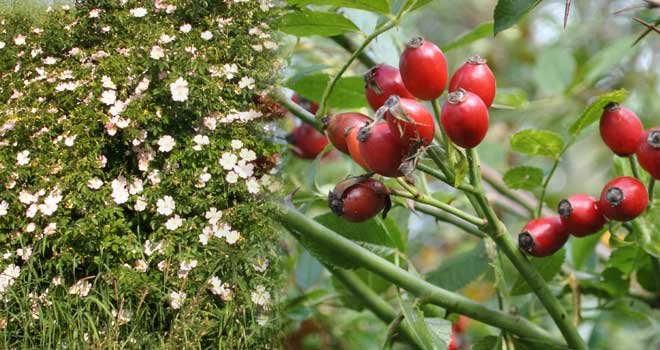
Rose (Rosa canina Rosaceae)
Other Names: Dog Rose, Wild Rose
This bushy rose grows wild in temperate regions worldwide, reaching a height of one to three meters. From May to early July, it produces beautiful pink or whitish flowers on thorny branches. After the petals fall, the inflorescence ripens, becomes fleshy, and turns red, forming the rosehip fruit, which contains seeds in its juicy interior.
Parts for Use
Rosehip
- Ripe rosehips are harvested from June to September, then dried and crushed into smaller pieces or ground into powder.
- Crushed or powdered rosehips are used to make infusions, decoctions, tinctures, or dry extracts.
- Wild rose is often combined with other plants, such as nettle and echinacea.
Ingredients
Rosehips are rich in vitamins C and B2, and also contain significant amounts of pectin, organic acids (notably malic and citric acid), and tannins. They also include proanthocyanidins, which act as protective antioxidants.
Use in Treatment
Rosehips, rich in vitamin C, serve as a tonic and help boost immunity. They are prescribed as an adjunct during treatment and recovery to strengthen resistance to infections like colds and flu. Tannins provide astringent properties, alleviating diarrhea, especially when caused by fever. Pectins and organic acids have diuretic effects, while organic acids stimulate digestive juice secretion, helping relieve gastritis. Recent research suggests rosehips may reduce pain and improve mobility in joints affected by arthritis.
Cultivation
Wild rose can be grown from cuttings in moist, well-drained, nutrient-rich soil, preferably neutral or slightly acidic, in a sunny location.
Preparation and Dosage
For Internal Use (Colds, Flu, Vitamin C Deficiency, General Fatigue)
- Infusion: Place two grams of crushed rosehip in a cup of boiling water, steep for 10 minutes, strain, and drink three to four cups daily.
- Capsules (50–200 mg dry extract): Take one to two capsules with water three times daily before meals.
- Tincture: Add 30 drops to a glass of water and take three times daily before meals.
For Internal Use (Diarrhea)
- Decoction: Place 30 to 50 grams of crushed rosehip in a liter of boiling water, simmer for five minutes, steep for 15 minutes, strain, and drink regularly, especially at breakfast.
Warnings
- Consult a healthcare professional before use.
- Do not use wild rose preparations during pregnancy or breastfeeding.